Cranes are crucial for construction, transportation, and business projects, permitting heavy lifting with precision and performance. However, selecting the proper crane for an activity relies on multiple elements, along with lifting capacity, peak, terrain, and maneuverability. In this blog, we’ll discover six common sorts of cranes, their capabilities, programs, and weight and height limits.
1. Crawler Crane: The Heavy-Duty Powerhouse
Crawler cranes are truck-mounted, heavy-responsibility cranes designed for heavy loads in hard terrain. Unlike wheeled cranes, their tracked machine offers stability and allows them to perform on tender or choppy surfaces without the need for outriggers.
They are usually used in big-scale infrastructure projects where mobility throughout terrain is needed.
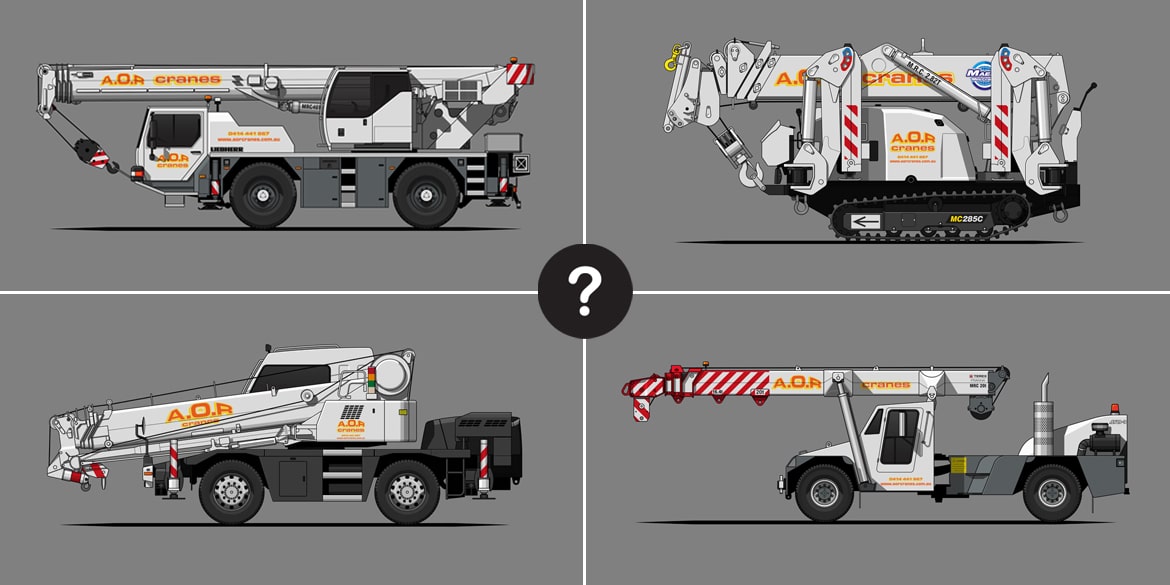
AOR has multiple options to choose from mini-crawler crane series with load bearing capacity of 2 to 4 tons.
Best Uses
- Large-scale infrastructure projects
- Bridge and dam construction
- Wind turbine installation
Weight & Height Limits
- Lifting capacity: 80–3,500 tons
- Maximum height: 100+ meters
Limitations
- Slow movement: Requires disassembly for transport.
- Large footprint: Needs big space for operation.
2. City Crane: Compact and Maneuverable for Urban Projects
City cranes are small, agile, and designed for limited spaces, making them perfect for construction in urban regions. They feature a compact chassis with a telescopic boom, allowing them to lift loads in narrow spaces.
Unlike larger cranes, city cranes can be driven on public roads without requiring permission for outsized shipping. Their key benefit is maneuverability, but they have a lower lifting capacity than large cellular cranes.
Easily hire a city crane from AOR Cranes, load-bearing capacity up to 20 tons.
Best Uses
- High-rise maintenance
- Tight-access construction sites
- Urban infrastructure projects
Weight & Height Limits
- Lifting capacity: 10–50 tons
- Maximum height: 30–60 meters
Limitation
- Lower lifting capacity: Not suitable for heavy-duty tasks.
- Limited reach: Best for mid-rise buildings.
3. Franna Crane: The Pick and Carry Specialist
Franna cranes, additionally known as pick-and-carry cranes, are quite mobile lifting machines without outriggers, allowing quick movement among process sites. They are designed to raise a load and ship it over short distances, making them the best for mining, business, and maintenance programs.
While their mobility is a bonus, they provide less stability as compared to cranes with outriggers and are not suitable for high-reach responsibilities.
Best Uses
- Mining and industrial maintenance
- Construction material movement
- Warehouse and factory lifting
Weight & Height Limits
- Lifting capacity: 10-40 tons
- Maximum height: 15-20 meters
Limitations
- Limited stability: No outriggers for extra support.
- Short lifting height: Not ideal for high-rise projects.
4. Tidd Crane: Precision and Safety in Tight Spaces
Tidd cranes are a present-day evolution of pick-and-convey cranes, imparting better safety capabilities and progressing operator visibility. They are designed to carry out precision lifts in constrained spaces, making them a top preference in railway protection and business programs.
Their lightweight build permits for smooth maneuverability; however, they have a lower lifting potential than Franna cranes.
Tidd cranes or Franna cranes choose best with AOR cranes
Best Uses
- Railway and maintenance projects
- Confined space lifting
- Industrial applications
Weight & Height Limits
- Lifting capacity: 12–25 tons
- Maximum height: 12–18 meters
Limitations
- Smaller lifting capacity: Limited compared to larger pick-and-carry cranes.
- Restricted reach: Best suited for precision lifts in compact areas.
5. All Terrain Crane: Versatility on Any Surface
All-terrain cranes combine the mobility of truck-mounted cranes with the off-road capabilities of hard-terrain cranes. They feature multiple axles, advanced suspension, and high lifting capability, making them appropriate for various job sites, from highways to faraway locations.
These cranes are equipped with telescopic booms and may travel on public roads, decreasing the need for added delivery equipment. However, they can be more costly to perform and require skilled operators.
AOR cranes provide multiple options of all terrain cranes, ranging from 40 to 100 tons of lifting capacity. Choose the best for your project.
Best Uses
- Wind farm installation
- Road and bridge construction
- Large-scale lifting in remote areas
Weight & Height Limits
- Lifting capacity: 50–1,200 tons
- Maximum height: 100–150 meters
Limitations
- Higher costs: Expensive to operate and transport.
- Requires skilled operators: Complex controls and setup.
6. Tower Crane: The Backbone of Skyscraper Construction
Tower cranes are the giants of the development enterprise, used for excessively upward thrust building projects. These cranes have a hard and fast base and an extended horizontal jib, allowing them to lift heavy materials to first-rate heights.
Due to their peak and balance, they’re essential for constructing skyscrapers and huge infrastructure initiatives. However, their setup and dismantling require cautious planning and specialized teams.
AOR Cranes has multiple tower crane options in height and lifting capacity. Check now.
Best Uses
- Skyscraper construction
- Bridge and stadium projects
- Large infrastructure development
Weight & Height Limits
- Lifting capacity: 2–25 tons
- Maximum height: 265 meters (self-supporting), over 500 meters (anchored)
Limitations
- Fixed position: Cannot be moved once installed.
- Time-consuming setup: Requires specialized assembly and dismantling.
Find the Right Crane with AOR Cranes
AOR Cranes offers a wide selection of top-notch cranes to hire in Sydney designed to meet a variety of demanding requirements. Whether you require heavy-duty lifting, urban maneuverability, or specialized precision cranes, we’ve got the right answer for you. Contact us for professional advice and reliable crane condominium services. Let’s lift your project to new heights!
AOR Cranes is dedicated to delivering top-notch crane hire services with safety, reliability, and expertise at the core. With over 30 years of experience, we handle every project with care and expertise to meet your needs.